 FREEPHONE
 CONTACT US
What Businesses Need to Know About Commercial Fire Alarms
For businesses across the UK, a reliable commercial fire alarm system isn't just a safety feature—it’s a legal requirement and a critical investment in your people, property, and operations. Yet for many business owners, landlords, and facilities managers, understanding exactly what's required under UK fire regulations can be confusing.
In this guide, we break down commercial fire alarm responsibilities: from legal obligations and risk assessments to avoiding the most common compliance mistakes. Whether you're responsible for a single unit or a large multi-occupancy building, this article will help you make informed, compliant decisions about commercial fire alarms, fire extinguishers, and security systems.
Read on to discover why maintaining your commercial fire alarm system is so important.
Understanding Your Legal Responsibilities
Under the Regulatory Reform (Fire Safety) Order 2005, if you’re responsible for a commercial premises in England, Wales, or Northern Ireland, you are the "responsible person." In Scotland, the Fire (Scotland) Act 2005 applies similar rules.
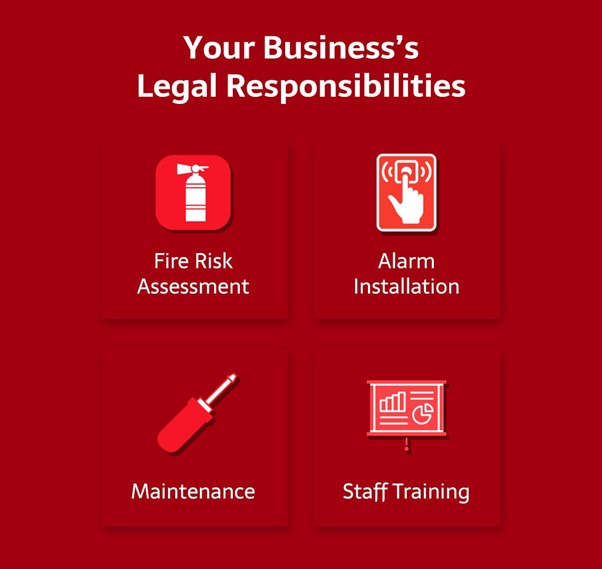
As the responsible person, you're legally required to:
- Carry out a Fire Risk Assessment (FRA)
- Install an appropriate business fire alarm system
- Provide suitable fire-fighting equipment (such as commercial fire extinguishers)
- Maintain all fire safety systems properly
- Ensure all staff receive appropriate fire safety training
Failure to meet these obligations can result in fines, prosecution, and invalidated insurance. Local fire and rescue services are responsible for enforcing these rules and can issue enforcement or prohibition notices following an inspection.
Fire Risk Assessments: Where Fire Safety Starts
Your fire risk assessment forms the foundation of your fire safety strategy. It identifies hazards, determines who might be at risk, and outlines the measures needed to reduce or eliminate the dangers.
The key steps include:
- Identifying fire hazards such as heat sources, electrical faults, and flammable materials
- Considering who is at risk, including staff, visitors, and vulnerable individuals
- Evaluating current safety measures and recommending improvements
- Recording your findings and creating an action plan
- Reviewing and updating the assessment regularly, especially after any changes to the premises or operations
This assessment will also determine the type of commercial fire alarm system you need, along with the placement of commercial fire extinguishers, signage, and emergency lighting.
While small, low-risk businesses may carry out their own assessments using government templates, many choose to work with qualified professionals for assurance and compliance.
Choosing the Right Commercial Fire Alarm System
Commercial fire alarm systems must be designed and installed in accordance with BS 5839-1 the British Standard for non-domestic fire detection systems.
There are two main types:
- Category L systems (Life protection): Designed to protect occupants. These range from L1 (full building coverage) to L5 (custom systems for specific risks).
- Category P systems (Property protection): Designed to protect the premises itself. P1 covers the whole building; P2 covers specific areas.
Your fire risk assessment will determine which type is required.
A complete commercial fire alarm system may include:
- Smoke and heat detectors
- Manual call points at exits and high-traffic areas
- Control panels for zone monitoring
- Audible and visual alarms such as sounders and beacons
- Optional voice alarm or emergency voice communication systems
- Monitoring systems that alert keyholders or the fire brigade
If you manage a multi-occupancy building, or premises with shared escape routes, additional alarm and detection requirements may apply under the Fire Safety (England) Regulations 2022.
Integration with Security Systems
Fire alarm systems can also be integrated with your security systems, creating a unified approach to building safety.
This integration can offer:
- Automatic alerts to monitoring centres (Alarm Receiving Centres)
- Linking of CCTV systems for real-time incident verification
- Controlled door releases during evacuations
- Centralised panels to manage fire, security, and access control
For larger premises or high-risk environments, integrating your systems offers improved response times and operational efficiency.
Fire Alarm Maintenance: A Legal Obligation
Installation is only part of your responsibility. Maintaining your fire alarm system is a legal requirement under BS 5839-1 and the Fire Safety Order.
What you need to do:
- Weekly tests: Test at least one manual call point weekly (rotate between zones)
- Monthly checks: Check for battery backup and visual issues
- Six-monthly servicing: A competent fire alarm engineer must inspect and test the system twice a year
- Annual inspection: Full system review and component testing
- Recordkeeping: Maintain a fire logbook documenting all tests, inspections, and incidents
A well-maintained system ensures early warning in the event of a fire—and reduces the likelihood of false alarms, system faults, and legal liability.
Fire Extinguishers: A Vital Companion to Alarms
While commercial fire alarms provide early detection, commercial fire extinguishers are your first defence against small fires before they escalate.
In the UK, the standard recommendations include:
- One Class A extinguisher for every 200–300 m² of floor space
- Specific extinguishers suited to your environment (e.g. foam for offices, CO₂ for electrical equipment)
- Clear signage and unobstructed placement
- Staff training on proper use
- Annual servicing by a BAFE-certified technician
Ensure extinguishers are the correct type, regularly maintained, and included in your fire risk assessment plan.
Common Mistakes to Avoid
Even well-intentioned organisations can fall short of compliance. Some of the most frequent issues include:
- Installing the wrong fire alarm category for the building or risk level
- Letting fire risk assessments become outdated after layout or occupancy changes
- Skipping weekly alarm testing and logbook entries
- Overlooking extinguisher maintenance
- Failing to train staff or assign fire wardens
Avoiding these mistakes helps you stay compliant, protects lives, and reduces business disruption in the event of a fire.
Working with a Trusted Fire Protection Partner
Fire safety can feel overwhelming—but you don't have to handle it alone. Choosing a qualified fire protection provider ensures your systems are fit for purpose, legally compliant, and properly maintained.
Look for providers who are:
- Accredited by BAFE or NSI
- Familiar with current UK standards (including BS 5839-1 and BS 5306)
- Experienced in risk assessments, system design, installation, and maintenance
- Able to provide integrated fire and security systems
- Responsive, reliable, and available for emergency call-outs
At Snowdonia Fire Protection, we provide tailored solutions for commercial properties across the UK. From alarm installation to extinguisher servicing and compliance advice, our team is here to help you protect what matters most.
Take Control of Your Fire Safety
Fire safety is more than a box-ticking exercise—it's about saving lives and protecting the future of your business. With the right commercial fire alarm system, professional support, and a proactive approach to compliance, you can meet your legal responsibilities and gain valuable peace of mind.
Need help with your fire alarm system or risk assessment? Contact us today for expert advice and dependable service.


